


A channel manager is software that connects your property management system to booking channels and syncs rates and availability in real time. It sits in a fast-growing market valued at USD 3.07 billion in 2025, with projections reaching USD 7.13 billion by 2034.
If you're managing a vacation rental on Airbnb, Vrbo, Booking.com, and maybe your own website, you already know the stress. One guest books on one site. You rush to block the same dates everywhere else. A channel manager is the tool that automatically syncs your rental's calendar and rates across all booking sites like Airbnb, Vrbo, and Booking.com from a single dashboard.
For many owners, the first time they look up the channel manager definition, they're not doing it out of curiosity. They're doing it because something already went wrong, or almost did. Maybe a guest reserved your condo on one site while your listing still showed open on another. Maybe you spent your evening logging in and out of extranets instead of answering guest questions or checking on cleaners.
That's why this technology matters. It's not just software. It's the difference between running your rental with confidence and feeling like you're one delayed update away from a costly mess.
The breaking point usually comes during a busy stretch.
You get a booking on Airbnb for a holiday weekend. Before you can update Vrbo and Booking.com, another reservation request comes in for the same dates. Now you're apologizing to a guest, issuing a refund, worrying about reviews, and trying to figure out how this happened when you were “keeping an eye on it.”
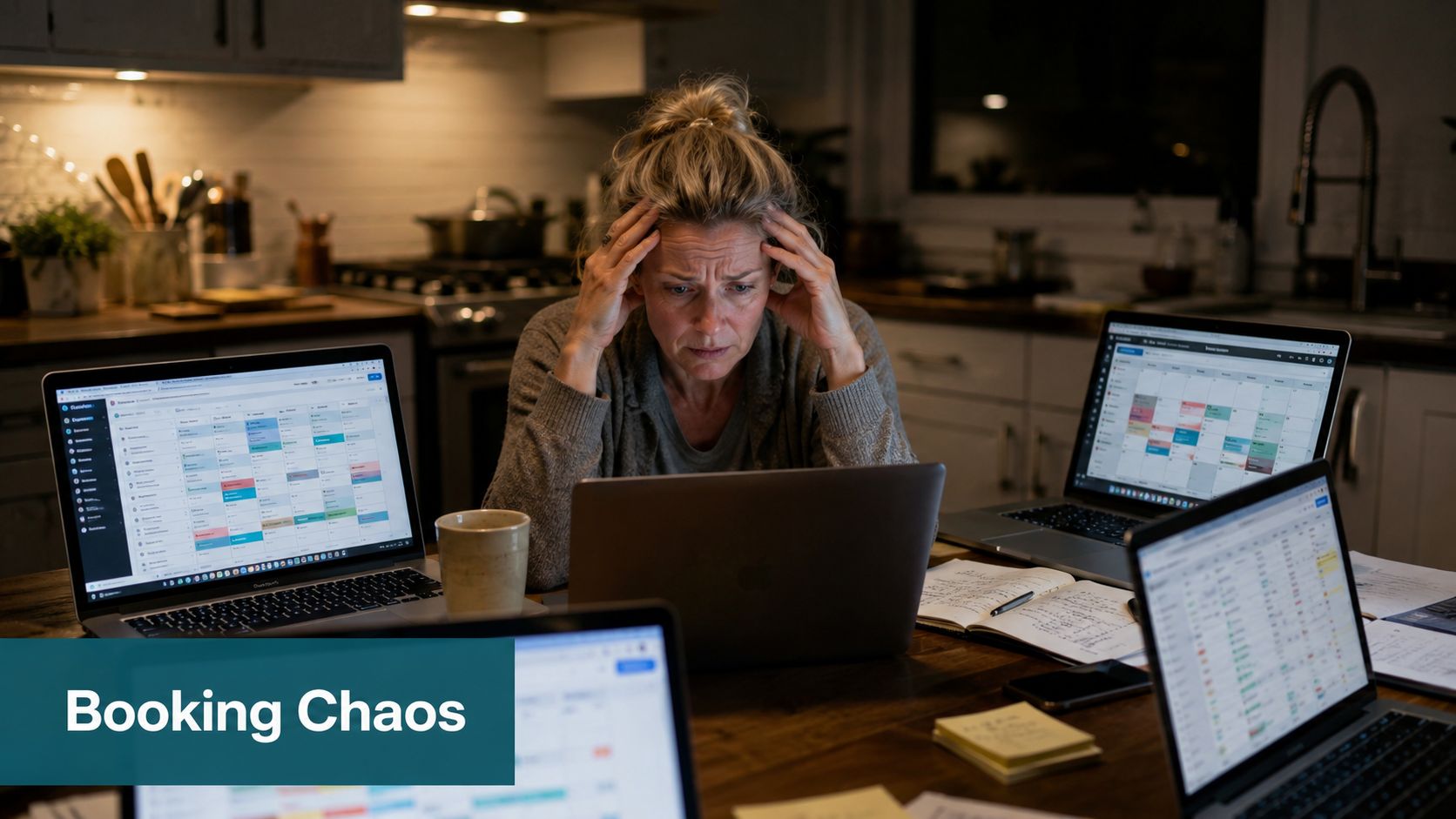
That kind of chaos is exactly why channel managers have become so important. The global channel manager software market is valued at USD 3.07 billion in 2025 and is projected to reach USD 7.13 billion by 2034, growing at a 9.8% CAGR, according to Business Research Insights on the channel manager market. Owners and operators aren't adopting these tools because they're trendy. They're adopting them because manual calendar management stops working once you list in more than one place.
A lot of new owners assume the problem is only double bookings. That's part of it, but not the whole story.
Booking chaos rarely starts with one big mistake. It starts with small manual tasks piling up faster than one person can manage.
If you're still deciding how this fits into your broader tech stack, this guide to property management software for vacation rentals helps clarify where channel management sits.
It can also help to hear how real hospitality businesses talk about service consistency and operational experience in public feedback, which is why browsing Testimonial.to reviews for All Seasons can be useful context when you're thinking about what reliable systems support behind the scenes.
The simplest channel manager definition is this: it's the software bridge between your internal system and the places where guests book.
Think of it as an air traffic controller for your property. Planes are constantly arriving and departing. In your rental business, those planes are bookings, cancellations, date blocks, rate changes, and listing updates. If every movement isn't coordinated from one control point, collisions happen.
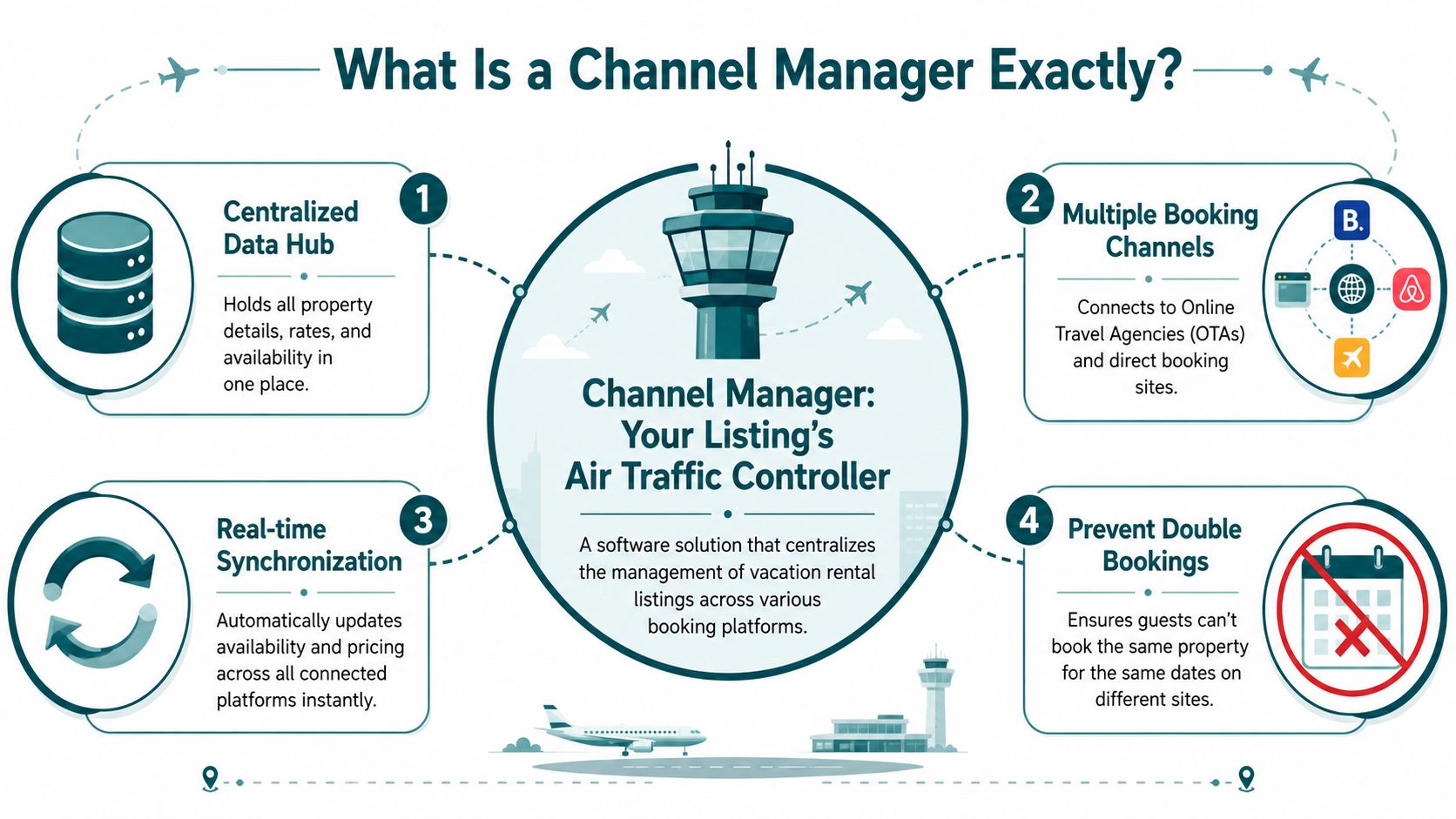
A channel manager is functionally defined as software that synchronizes a supplier's Property Management System, or PMS, with external platforms like OTAs in real time, according to Software.travel's channel manager glossary.
Simple definition: A channel manager keeps your calendars, rates, and availability aligned across all the places you sell your rental.
That means if someone books your cabin on Booking.com, the software updates your PMS and pushes the new availability to your other connected channels right away. No manual copying. No logging into five dashboards.
Many new hosts often get stuck on this point. A Property Management System handles your internal operations. Think reservations, guest records, housekeeping tasks, and sometimes payments. A channel manager handles distribution. It pushes your inventory and pricing outward to the channels where guests find you.
If you want a fuller breakdown of that broader system, this article on what property management software is is a helpful companion read.
Under the hood, a modern channel manager uses a two-way API connection. That sounds technical, but the practical meaning is simple.
Here's the important part. This is not just a one-way broadcast tool. It doesn't only send your rates out to Airbnb or Expedia. It also pulls reservations back into your main system.
Your PMS becomes the source of truth, and the channel manager becomes the dispatcher.
That's why the air traffic controller analogy works so well. The controller doesn't fly the planes. The controller coordinates movement so the whole system stays safe and orderly.
The easiest way to understand a channel manager is to follow one booking from start to finish.
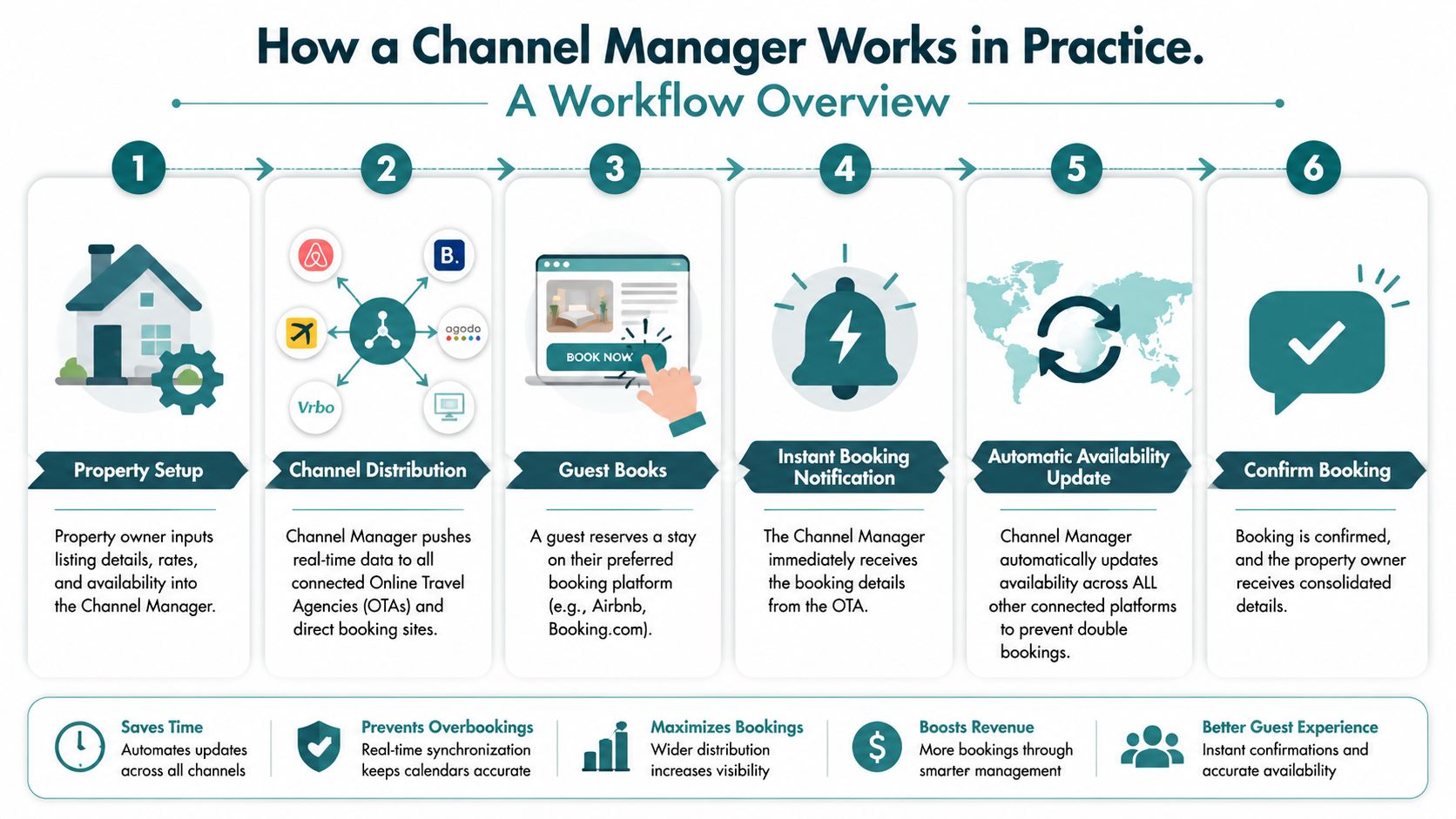
Let's say you manage a two-bedroom beach condo listed on Airbnb, Vrbo, Booking.com, and your own direct booking site.
That is the practical value. One booking triggers one coordinated response.
The reverse flow matters just as much.
If you block off dates for personal use, schedule maintenance, or close part of a season while you repair storm damage, you make that change once in your main system. The channel manager then pushes the update to your connected channels so guests can't book dates you no longer want to sell.
This same central-distribution idea shows up in other industries too. For example, real estate teams use tools to syndicate real estate listings so one property update can flow across multiple portals without separate manual edits.
Without a channel manager, you become the sync engine.
With the right mobile-friendly setup, you can also manage this process more easily from anywhere, which is why many owners compare tools before settling on one of the best property management apps.
One booking should create one update. If one booking creates five manual tasks, your system is still fragile.
A lot of owners stop at the most obvious benefit: preventing double bookings. That's important, but it undersells what a good channel manager does.
A channel manager also acts as a strategic digital control center that automates rate management and provides performance analytics, helping owners optimize pricing and identify stronger channels, as explained by RateGain's overview of channel managers.
If you've ever changed prices manually across several platforms before a holiday, you know how easy it is to miss one.
With centralized rate management, you can:
That becomes even more useful if you're also learning how dynamic hotel pricing works, because pricing strategy only helps when you can apply it quickly across channels.
Not every booking source pulls its weight.
Some channels bring you cleaner bookings, longer stays, better lead times, or fewer support headaches. Others generate inquiries but low-quality conversions. A strong channel manager helps you see those patterns through reporting.
That leads to better decisions, such as:
Owner mindset: Don't treat every booking source as equal. Use your data to decide where your best business actually comes from.
Operational calm is a real business benefit.
When your listing content, inventory, and rate changes flow from a central point, your day becomes more predictable. You spend less time checking whether a date change “went through” and more time on guest communication, maintenance planning, and owner-level decisions.
Here's a simple feature-to-benefit view:
| Feature | What it does for you |
|---|---|
| Real-time syncing | Reduces booking conflicts and manual calendar work |
| Centralized updates | Lets you manage multiple channels from one dashboard |
| Rate automation | Helps you react to seasonality and promotions faster |
| Performance reporting | Shows which channels contribute the strongest results |
| Content distribution | Keeps listing details more consistent across platforms |
A good channel manager doesn't just help you avoid mistakes. It helps you run your rental like a coordinated business instead of a collection of separate listings.
Choosing a channel manager is less about flashy features and more about fit. The best one for a single cabin owner may not be the best one for someone managing a portfolio across several markets.
One issue deserves special attention: rate parity. A 2024 industry report indicates that 42% of hoteliers struggle with rate parity violations despite using channel managers, according to SiteMinder's guide to hotel channel managers. That tells you something important. Buying software isn't enough by itself. You need one with tools that help you monitor and control pricing consistency.
Start with the connections.
The cheapest-looking option isn't always the cheapest in practice. Some tools charge a flat recurring fee. Others may tie cost to bookings, channels, or commissions.
Here's a simple comparison.
| Model Type | Cost Structure | Best For | Example |
|---|---|---|---|
| Flat fee | One recurring software fee | Owners who want predictable budgeting | A host with several active channels who wants stable monthly software costs |
| Per booking | Cost rises as reservations come in | Owners with lighter booking volume or seasonal use | A vacation home that rents only part of the year |
| Percentage based | Provider takes a share tied to booking activity | Owners comparing lower upfront cost against variable ongoing expense | A manager testing a new market before committing to a fixed tool |
| Per channel | Cost changes based on connected platforms | Owners using only a small number of booking sites | A single-property owner listed on a limited set of OTAs |
Ask direct questions in demos. Don't settle for polished screens.
A strong channel manager should make your business simpler on a stressful day, not just look impressive during a sales demo.
The right choice is the one that matches your portfolio, your workflow, and the way you want to grow.
Most owners expect setup to feel technical and messy. In reality, it's usually a guided process if you approach it in order.
The biggest errors usually happen during mapping and testing.
If the wrong room type or listing gets linked, the software can still sync perfectly, but it will sync the wrong thing. That's why careful review matters at the start. Take your time, confirm each property match, and run test scenarios before you trust the system with live inventory.
Once setup is done correctly, the day-to-day workload usually gets much lighter.
No. They work together, but they do different jobs.
A PMS handles internal operations like reservations, guest records, and housekeeping workflows. A channel manager handles external distribution by syncing rates and availability across your booking channels.
Often, yes.
Even one property can create a surprising amount of admin work when it's listed on multiple sites. If you're updating rates manually, blocking calendars by hand, or worrying about overlapping reservations, the value isn't only financial. It's also peace of mind.
Yes.
Your direct booking site can be part of the same connected ecosystem. When a guest books directly, your availability can still update across the rest of your channels, which helps you keep control while protecting your inventory.
Usually, yes.
Depending on the system, a channel manager can also help sync rates, restrictions, and some listing content. The exact scope depends on the channels you use and how deep each integration goes.
You can still benefit.
The fewer channels you use, the easier it is to manage manually, but problems still happen. A channel manager becomes more valuable as soon as you want tighter control, less repetitive admin, and room to expand.
If you plan to grow beyond one or two booking sources, putting the right system in place early is often easier than untangling a messy setup later.
A good channel manager gives you one place to control movement across your booking ecosystem. That's the heart of the channel manager definition. It's not just software. It's the control tower that keeps your rental business running smoothly.
If you'd rather not piece together the tech, pricing, guest communication, and day-to-day operations on your own, Global can help. Their team works with vacation rental owners to improve income, manage operations locally, and take the daily burden of short-term rental management off your plate.
Partner with a team that knows Florida—and your home—inside and out. From guest care to local flair, we manage every detail.