


You've got occupancy on the calendar, but the money still feels stuck. Rates inch up, cleaning and turnover costs keep coming, and the month ends without the margin you expected. That's usually the moment property owners realize that filling nights and optimizing revenue are not the same job.
| Approach | Control Level | Effort Required | Best For |
|---|---|---|---|
| In-house strategy | High | High | Owners who want full control and already understand pricing, seasonality, and market pacing |
| PMS-integrated dynamic pricing tools | Medium | Low to medium | Owners who want automation tied to their property management stack |
| Third-party optimization services | Medium to high | Medium | Owners who want external strategy without full operational outsourcing |
| Managed revenue teams | Low to medium | Low | Owners who want pricing, forecasting, and execution handled as part of a broader service model |
A useful way to evaluate revenue optimization solutions is to treat them as a spectrum of control, not a software shopping list. At one end, you make every pricing call yourself. At the other, a managed team handles pricing strategy alongside distribution, pacing, and adjustments. In the middle sit tools and services that automate some work but still depend on how well you define goals, guardrails, and operating rules.
That matters because the right answer depends on capacity, not just ambition. A single-home owner with limited time has different needs than a portfolio operator who tracks multiple calendars, owner-use blocks, and channel constraints. A strong comparison also goes beyond nightly rate and asks whether the approach improves total calendar performance, booking pace, and risk control.
If you're also thinking about attribution and demand generation, travel marketing attribution can help connect acquisition activity with booking outcomes, which matters when pricing and marketing decisions interact. And if your distribution stack is already in place, a clear view of your channel manager definition helps separate rate strategy from inventory control.
A vacation rental can look healthy on paper and still miss revenue targets in practice. A calendar may stay full, but if peak dates are underpriced, slower dates sit idle, and late discounts cut into margin, the property is active without being efficient. Revenue optimization solutions exist to close that gap.
The basic idea is to adjust price, availability, and booking rules as demand changes, rather than hold one fixed rate all year. That matters in vacation rentals because each unbooked night disappears once the date passes. Inventory is limited and time-sensitive.

The central choice is how much of the work stays in-house. Some owners set prices manually and rely on local knowledge. Others use software tied to their PMS, which can adjust rates automatically. A third group outsources strategy to specialists, while a fourth hands most commercial decisions to a managed team.
Practical rule: choose the approach that matches your operating bandwidth first, then judge it by how well it improves total revenue, not by how many features it advertises.
That choice also depends on how well pricing, calendar control, and channel control stay aligned. Owners who want a broader framework for distribution and revenue decisions can use an explainer on what a PMS system does and a clear view of travel marketing attribution to see how pricing and demand generation affect booking outcomes. A channel manager definition also helps separate rate strategy from inventory control.
A vacant night cannot be sold after the date passes, so the economics of revenue optimization start with timing as much as price. The modern playbook began in airline yield management after U.S. deregulation forced carriers to compete more directly on fares and seat allocation. The Airline Deregulation Act became law on October 24, 1978, and airlines had to become much more precise about how they sold seats. American Airlines later used computerized systems to allocate seats across fare classes and introduced its Ultimate Super Saver fares in 1985, a move that helped produce a 14.5% increase in revenue and a 47.8% increase in profit over the following year. The practical lesson is clear, the model was tied to measurable business outcomes, not just theory. INFORMS history of revenue management
Hotels fit the same revenue pattern. Room inventory is fixed in the short run, demand changes by segment and booking timing, and unsold inventory expires once the stay date passes.
Marriott was an early large-scale adopter, and historical accounts of its revenue-management program estimate about $150 million to $200 million in additional annual revenue by the mid-1990s. That matters because it showed the method could move from seats to rooms without losing commercial value. Marriott revenue management program history
By 2000, airlines, hotel companies, cruise lines, and rental-car firms were using the same basic logic. Prices could vary by demand, customer segment, booking timing, and remaining capacity. For vacation rentals, that means the property should be managed less like a static listing and more like a time-limited revenue asset.
A room that stays unsold tonight cannot be sold tomorrow.
For owners who want to understand how commercial systems connect to operational data, WebscrapingHQ on hotel data pipelines is a useful reference point, because pricing decisions are only as strong as the data feeding them. PMS strategy guidance also matters here, since pricing works best when inventory, restrictions, and channel flow are managed together.
The four main paths to optimization solve different problems. In-house pricing gives you direct control, but it also makes you responsible for forecasting, market monitoring, event tracking, and rule setting. That can work for experienced owners who enjoy the work and have the time to watch the market closely.
PMS-integrated dynamic pricing tools automate a lot of that burden. They can adjust rates based on market signals, which reduces manual effort and helps owners stay responsive when demand shifts quickly. The trade-off is that automation still needs oversight. If your calendar has owner-use periods, stay rules, or odd-length gaps, the software can only work as well as the guardrails you define.
Third-party optimization services sit between software and full management. They usually bring strategy, benchmarking, and monitoring, while leaving ownership and final control with you. Managed revenue teams go further, folding pricing into a broader operational relationship that can also cover distribution, guest operations, and maintenance coordination. For some owners, that creates simpler decision-making. For others, it means giving up too much direct control.
The right choice usually comes down to three questions.
For a practical example of automated pricing inside a broader rental workflow, dynamic hotel pricing guidance shows how rate changes fit into daily operations rather than standing alone. If you're comparing service models, Global is one option in the market, since it combines vacation rental management with dynamic pricing, guest relations, maintenance, and revenue optimization in one operating structure.
The key distinction is whether you need a tool, a strategist, or an outsourced commercial function. A tool helps you act faster. A strategist helps you decide better. A managed team reduces the burden of doing both.
A revenue strategy can look effective until the numbers are tested against the outcome it produced. The better question is whether price, fill rate, and market position moved together. A practical framework starts with ADR, occupancy, and RevPAR, because those metrics show whether rate and demand are aligned. For a broader view of how marketing metrics connect to revenue, see this LLMrefs performance metrics breakdown and the Revenue management metrics framework.
ADR measures revenue per sold night. Occupancy shows the share of available nights sold. RevPAR combines the two, so it is more informative than either metric on its own when you are checking whether a pricing change improved night-level revenue. ARI adds market context, and the formula is simple, property ADR / market ADR × 100. An ARI below 100 means your pricing sits below the defined competitive set, which is useful context even when the rate itself looks acceptable in isolation.
Internal growth can still miss the market. That is why ARI belongs next to rate and occupancy, not after them. A property can lift revenue by discounting harder, while still losing ground to comparable competitors.
Practical rule: review pricing with more than revenue alone, because revenue can rise while discounting becomes more aggressive than intended.
Forecasting should also reflect historical booking patterns, market demand, local events, holidays, and unconstrained demand. A system can compare expected demand with actual pickup and show whether weak dates were filled efficiently or sold too cheaply. For a management-oriented view of dashboards and reporting, smart rental property management shows how operators can keep pricing, operations, and measurement connected.
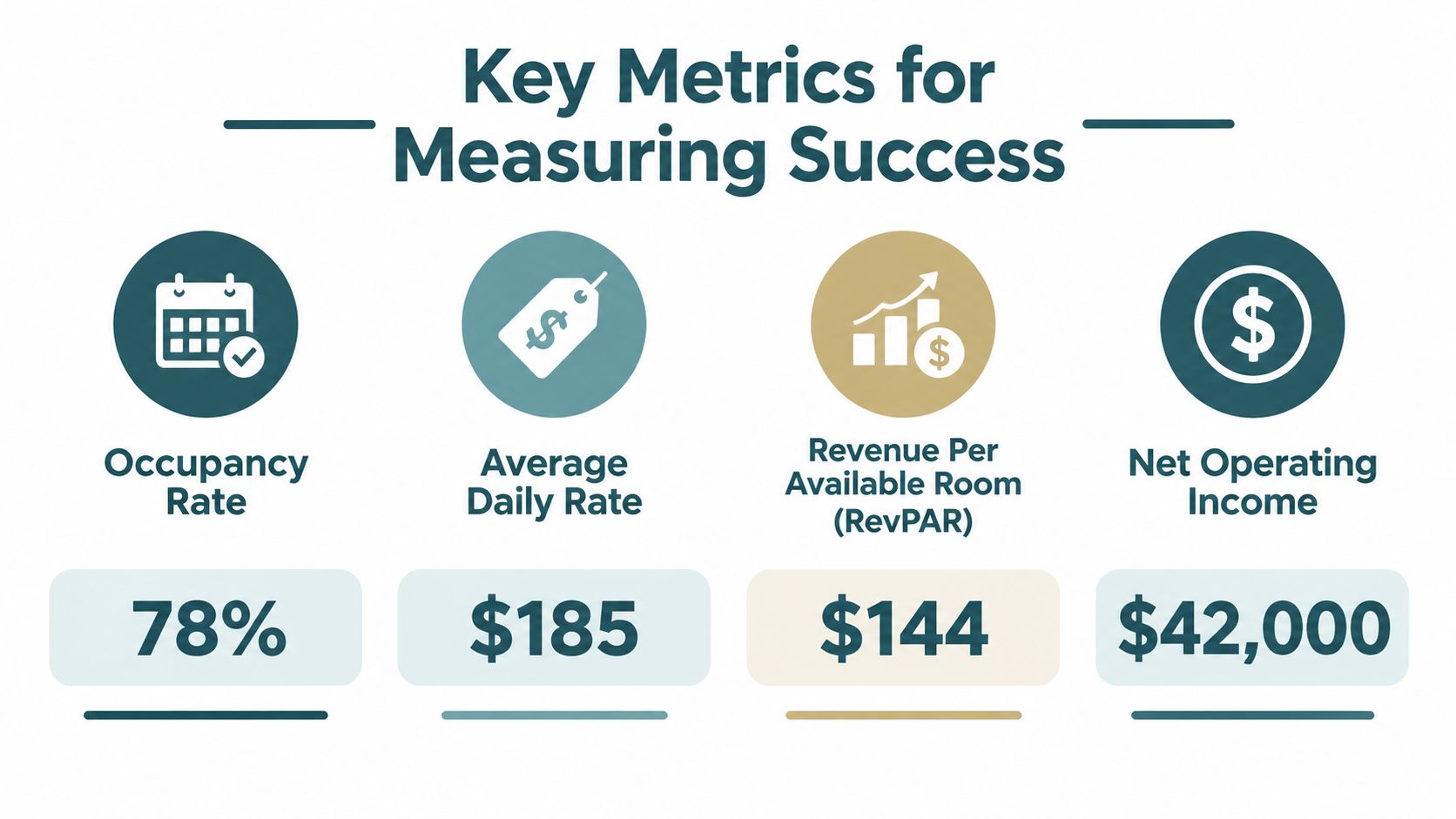
A useful dashboard makes trade-offs visible. It should show whether automation is filling soft nights without cutting too much into high-demand periods, and whether the result still supports net operating income. If it cannot separate those effects, it measures activity, not optimization.
Dynamic pricing gets most of the attention because it's easy to explain. Raise rates when demand is strong, lower them when it's weak. That logic is useful, but it breaks down when booking behavior changes faster than the pricing rules do. A 2025 U.S. vacation-rental dataset showed travelers booking about 55 to 75 days before arrival in late 2025, down from roughly 60 to 80-plus days previously, which means the window for rate decisions has shortened. Vacation-rental booking window data
When guests book later, a higher nightly rate can protect ADR but hurt conversion. A lower rate can fill dates, but it may also attract shorter stays, more turnover, and more cleaning friction. The right decision depends on total contribution, not on whether the rate looks strong in isolation.
That's the part many owners miss. They optimize the visible number, the nightly rate, while the key question is whether the calendar produces the best return after turnover costs, owner blocks, and stay restrictions. Longer booking windows used to give owners more room to recover from bad calls. Shorter windows leave less time for correction.
Compliance risk belongs in the same conversation. A 2025 economic analysis of New York City's Local Law 18 estimated $197 million in lost host income and $638 million in lost business revenue after restrictions took effect. Those numbers show why regulation can change the size and shape of the revenue opportunity, not just the cost structure. Local Law 18 economic analysis
Compliance affects how much inventory you can legally sell, how often you can sell it, and how much friction sits between demand and realized revenue.
The harder lesson is that the highest gross-revenue path isn't always the best risk-adjusted outcome. A restrictive market can shrink operating days, taxes, or fees. A lighter-touch market can leave more room for revenue, but still demand tight forecasting. The best owners model regulatory exposure, booking pace, and stay length together instead of treating laws as an afterthought.
The right solution depends on how much control you want to keep and how much time you can realistically spend on pricing. If you own a single property and want to stay involved, an in-house or PMS-integrated setup may be enough, especially if you're willing to review calendars regularly and adjust restrictions manually when needed. If you manage multiple homes or have uneven seasonal demand, the value of a third-party strategist or managed revenue team rises because consistency becomes harder to maintain by hand.
Owners who like direct control usually prefer software that gives them the final say. Owners who want fewer moving parts usually do better with a managed model that treats pricing as part of a broader operating system. The wrong choice is the one that looks efficient on paper but doesn't fit your actual workflow.
A useful test is simple. Ask whether the solution helps you improve RevPAR, understand ARI, and reduce bad pricing decisions during weak periods. If it can't show that in reporting, it's not giving you much more than a prettier rate calendar.
For many vacation rental owners, the smartest move is to start with measurement before automation. Define the benchmark, watch the pickup, and only then decide whether to delegate more of the work. That sequence protects you from buying sophistication you don't need or outsourcing control you still depend on.
If you want a management model built around revenue, guest operations, and local execution, visit Global. Their team works with vacation rental owners who want pricing and operations handled together, so you can compare whether a managed approach fits your portfolio and your goals.
Partner with a team that knows Florida—and your home—inside and out. From guest care to local flair, we manage every detail.